









On October 15, 2025, a drone carrying an improvised explosive device flew over a crowded neighborhood in Tijuana and detonated inside the anti-kidnapping unit of the Baja California Attorney General’s Office. Mexican authorities believe the attack was carried out by a major organized crime group with the intent of disrupting investigative activities and intimidating law enforcement in the region. The explosion damaged multiple vehicles, forced the evacuation of personnel, and temporarily halted critical investigative work.
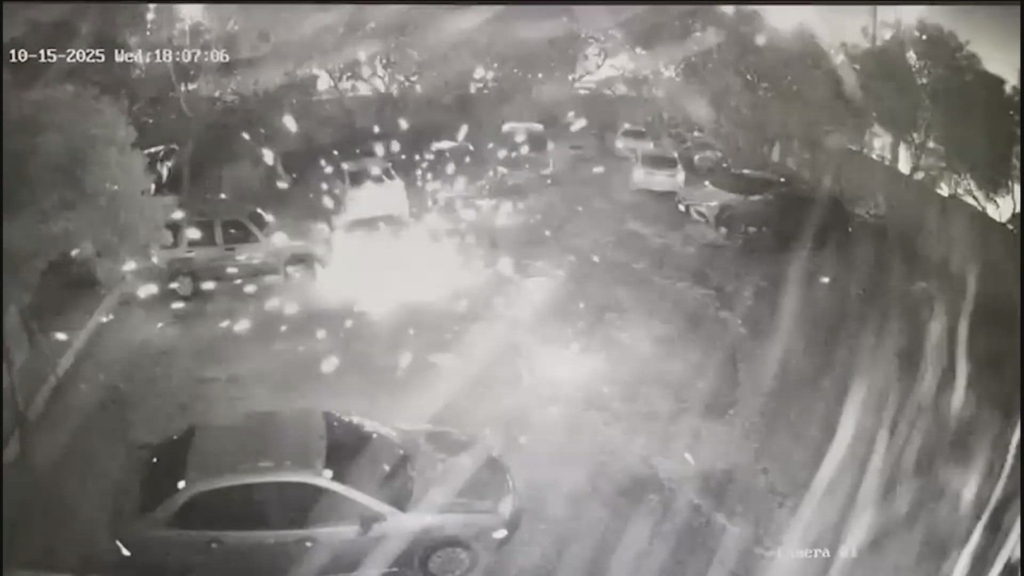
Image source: CBS8
While no casualties were reported, the intent behind the strike was clear. Targeting a specialized investigative unit responsible for dismantling kidnapping networks demonstrated both a willingness to escalate violence and an ability to reach sensitive facilities from above, without direct confrontation.
This incident is not an anomaly. It reflects a broader pattern in which criminal actors are increasingly using small, commercially available or DIY drones to attack, surveil, or pressure law enforcement agencies. These devices allow hostile actors to operate from within dense urban environments, exploit structural blind spots, and challenge long-standing assumptions about how police facilities are protected. For agencies tasked with safeguarding personnel and maintaining investigative continuity, the implications are immediate and significant.
Viewed alongside similar incidents around the world, the Tijuana attack shows how quickly drone tactics are evolving and how effectively they exploit urban conditions. To understand what this means for law enforcement, it is necessary to look beyond the event itself and assess both the threats and the measures to counter them. With that in mind, let’s look at five key lessons that law enforcement agencies must pay attention to.
Lesson 1: Criminal Groups Are Integrating Drones into Attacks on Law Enforcement Assets
The Baja California incident reflects a growing trend in which criminal groups are increasing their use of armed drones and turning unmanned aerial systems into a central operational tool. This evolution resembles military-style tactics more than traditional organized crime activity.
Criminal organizations are integrating drones into their operations both as a general show of force and as part of deliberate, targeted actions designed to disrupt law enforcement operations. In this case, the drone was used intentionally against an investigative unit, combining operational impact with a clear psychological message. It is reasonable to assume that the attack was preceded by intelligence gathering, surveillance, and identification of vulnerabilities in both the facility and its surrounding environment.
The incident demonstrates how easily seemingly protected physical assets in urban environments can be targeted from the air. Drones can reach restricted areas rapidly, without physical obstacles or direct confrontation, creating operational friction while exploiting the limited visibility and control that agencies have over low-altitude airspace. At the same time, such attacks carry both physical and psychological impact, amplifying their effect beyond the immediate damage.
The transition from improvised drones to coordinated, precision aerial weapons is a growing concern for law enforcement agencies, as the boundaries between criminal organizations and military-style units continue to blur. While earlier attention focused primarily on the use of explosive-laden drones against rival criminal groups, the Baja California incident, alongside other drone attacks targeting law enforcement, signals a shift that cannot be ignored, particularly in dense urban environments.
Lesson 2: Urban Airspace Creates Operational Blind Spots That Criminals Exploit
Urban environments create conditions that make low-altitude airspace difficult to monitor and even harder to secure. Most law enforcement facilities were designed to defend against threats at ground level, relying on physical barriers, access control, patrols, and horizontal surveillance. None of these systems provide consistent visibility into the narrow aerial corridors formed by surrounding buildings. A drone navigating between structures or descending behind a roofline can remain out of sight until it is already at the target.
These architectural features are not anomalies; they are inherent to cities. Dense construction patterns, irregular roof heights, and the proximity of residential and commercial buildings create persistent blind zones that interfere with optical, radar, and acoustic detection. Short distances within cities compound the problem. A drone launched from a nearby building or courtyard can reach a facility in seconds, leaving almost no opportunity for officers to identify or assess the threat before impact.
Ambient noise adds another layer of concealment. Traffic, construction, and constant movement mask the already low acoustic signature of small drones, making it difficult for personnel on the ground to detect an approaching device. At the same time, cities host a mix of legitimate airspace users, from emergency services and media teams to commercial and recreational drones. Distinguishing an unauthorized device from routine urban activity can be challenging, especially when hostile actors exploit these conditions to blend in.
These conditions give criminal groups a predictable advantage. They allow drones to approach sensitive facilities faster than agencies can detect or respond, turning ordinary city structures into cover that shields hostile activity. For law enforcement, this means that low-altitude urban airspace is becoming a key operational blind spot, one that adversaries already understand how to exploit.
Lesson 3: Traditional Security Layers Are Not Designed for Low-Altitude UAS Threats
Law enforcement facilities have long relied on layered security systems built to detect and deter threats approaching on foot or by vehicle. Gates, barriers, access controls, CCTV networks, and patrol routines form an architecture that works well for ground-based risks. But none of these systems were designed with the expectation that a threat could bypass every layer by coming from above, moving through the narrow spaces between buildings, or descending directly onto an otherwise secured compound.
Ground-oriented surveillance is a central limitation. Cameras, security teams, and monitoring procedures are structured around horizontal visibility. They track movement across courtyards, entrances, parking areas, and access points, not airspace a few meters above the roofline. When a drone approaches through an elevated corridor or drops into a facility from behind a structure, it does so outside the field of view of the tools officers depend on.
Aviation tools offer little support in this environment. Radar systems used for air traffic management are calibrated to detect large, cooperative aircraft operating at altitude. Small drones flying close to buildings, at low speeds, or below rooftop level fall beneath their detection thresholds. Urban architecture compounds the issue by blocking or distorting radar signals, creating gaps that operators can use to navigate directly toward a target.
Mitigation technologies based on signal disruption or deception also face structural and regulatory constraints. Broad-spectrum jamming can interfere with emergency communications, cellular networks, or critical infrastructure systems, making it unsuitable for densely populated areas and, in many jurisdictions, prohibited by law. Spoofing techniques, which attempt to mislead a drone’s navigation system, have similarly limited utility. Safeguards designed to reduce their susceptibility to basic spoofing techniques, and in complex urban environments these methods can lead to unpredictable flight behavior that increases the risk to people or property. As a result, tools that rely on interference or deception provide limited practical value for agencies operating in cities.
Even where certain mitigation tools are authorized, dense populations and sensitive infrastructure restrict their use. Kinetic interceptors cannot be deployed safely above crowded streets or near critical assets. Agencies must weigh operational responses against the risk of collateral harm or unintended disruptions to communications systems.
The result is a lack of real-time visibility and limited control over the domain where these threats develop. The airspace below roughly 400 feet, which is the regulatory ceiling for most civil drone operations, remains largely unmonitored in many jurisdictions, leaving law enforcement with few indicators that a drone is approaching. In several recent incidents, agencies became aware of the threat only when a device was already overhead or after it detonated, highlighting how legacy systems provide limited awareness and even less opportunity for timely intervention.
These gaps reflect a fundamental challenge: the security infrastructure that protects law enforcement facilities on the ground does not extend into the low-altitude airspace that drones exploit. As long as agencies depend on systems built for a different threat profile, adversaries will continue to find opportunities to reach sensitive locations with minimal effort and cost.
Lesson 4: Regulatory Constraints Limit How Law Enforcement Can Respond
Even when a drone threat is clearly identified, law enforcement agencies often face a narrow set of legally permissible responses. Low-altitude urban airspace is governed by strict aviation and communications regulations designed to prevent unintended harm, protect national infrastructure, and preserve the integrity of authorized air operations. These rules exist for good reason, but they also shape the practical realities of how agencies can act during a drone incident.
In many legal frameworks, any device capable of flight is legally classified as an aircraft, which means that interfering with it requires explicit authority. Actions that might seem straightforward in an emergency, carry legal implications if taken without proper authorization. This creates a challenging dynamic: the threat moves quickly, but the surrounding framework struggles to keep pace.
Urban environments introduce even more constraints. Areas near flight paths or strategic assets require coordination with aviation authorities before defeating actions can be taken. Agencies must ensure that any response does not endanger other aircraft, interfere with navigation systems, or disrupt communications used by emergency services. As a result, even in urgent situations, law enforcement agencies may have limited ability to act immediately.
These restrictions directly influence which technologies can be deployed. Many forms of electronic interference are heavily regulated because of their potential to disrupt critical communications infrastructure. Kinetic tools, while effective in controlled settings, present unacceptable risk in crowded areas where falling debris could harm civilians or damage property. The regulatory landscape therefore narrows the range of options available to law enforcement at precisely the moment when time and clarity are most critical.
The operational effect is clear. Agencies can detect a threat and still lack the legal authority to intervene in ways that would resolve it quickly. This gap underscores the need for counter-UAS capabilities that operate within established aviation and communications rules, support precise and predictable outcomes, and allow for a decisive response without risking legal or safety violations. In cities where every second matters, the ability to act within these boundaries is as important as the technology itself.
Lesson 5: Modern Counter-UAS Capabilities Need to Be Precise, Scalable, and Safe
Drone threats in cities develop quickly and leave little room for guesswork. Law enforcement agencies need counter-UAS capabilities that provide clarity and control without creating new risks for the public or interfering with authorized airspace. Precision, scalability, and predictable outcomes are central to supporting operations in dense, multi-use environments.
One of the major challenges is distinguishing unauthorized drones from legitimate activity. Cities host emergency services, media teams, commercial operators, and hobbyists, all using the same low-altitude airspace. Tools that rely on broad interference or force are difficult to apply in these settings because they can disrupt communications, risk collateral harm, or fall outside regulatory boundaries. Agencies need methods that enable them to act confidently while staying within strict legal and safety constraints.
Clarifying the Picture, Reducing Noise, and Enabling Complete Control with Cyber over RF
This is where approaches focused on the communication link, such as Cyber over RF, offer meaningful value. By analyzing the protocol-level interaction between a drone and its operator, these systems provide a clearer understanding of what the device is, how it is behaving, and whether it belongs in the area. This visibility is especially important in urban environments, where visual signatures are unreliable, and radar performance is often limited by buildings and clutter. Because Cyber over RF methods do not require broad-spectrum interference, they can operate without affecting emergency communications or other authorized systems — an essential requirement in city settings.
For law enforcement, this approach supports controlled, predictable mitigation. Cyber over RF enables responses designed for dense environments, such as guiding a drone to a safe landing or preventing it from completing its mission. In addition, the ability to determine the location of the drone’s operator provides significant value, supporting attribution and follow-on enforcement actions. These outcomes align with regulatory expectations while preserving critical telemetry and communication data.Flexibility remains important. Agencies operate across fixed facilities, mobile patrol routes, temporary investigative sites, and large public events. Counter-UAS capabilities need to adapt to these different operational contexts rather than rely on a single deployment model. Some environments benefit from continuous monitoring, while others require portable or mobile systems that can respond to emerging threats or move with teams as conditions shift. What matters most is that the technology integrates into the varied settings where officers work and provides reliable situational awareness at the moment it is needed.
Navigating the New Operational Reality
The attack in Baja, alongside other documented incidents, highlights how low-altitude urban airspace has become an active domain where criminal groups can shape conditions on the ground, disrupt investigations, and challenge the resilience of law enforcement agencies. The lessons emerging from these incidents reveal an environment in which visibility, response options, and regulatory boundaries intersect in ways that demand new approaches. For agencies, adapting to this reality means treating urban airspace as part of the operational landscape and investing in capabilities that provide clarity, control, and safe intervention. Those that evolve their tools and frameworks accordingly will be better positioned to protect personnel, facilities, and critical investigative functions as drone activity continues to expand.
FAQ
Why are criminals increasingly using drones in cities?
Urban areas give drone operators several tactical advantages that ground-based threats do not. Dense construction provides concealment, short distances reduce detection windows, and the attacker can remain far from the target while blending into routine activity. For organized crime, this combination offers a low-risk way to disrupt operations or signal intent without physical confrontation.
What legal factors influence how law enforcement responds to a drone incident?
Airspace, communications, and interference regulations shape what actions agencies may take in real time. Many regulatory frameworks restrict jamming or manipulation of navigation signals because of the potential impact on emergency communications and other authorized aviation. Any response often requires coordination with aviation authorities, especially in controlled or sensitive airspace. These rules are designed to protect the public but limit rapid intervention.
Can police legally stop a drone flying over a city?
Authority varies by country and region. In many legal frameworks, drones are classified as aircraft, which limits how and when they can be interfered with. While direct mitigation may require specific authorization, law enforcement can often act against the drone’s operator, including locating and apprehending the pilot, using existing legal powers.
How do different deployment models support law enforcement operations?
Different operational environments benefit from different types of coverage. Some facilities require continuous monitoring, while mobile teams may need airspace awareness as they move between locations. Temporary investigative sites, large gatherings, or public events may call for portable systems that can be quickly established and relocated. Agencies tend to adopt a mix of approaches based on mission needs, geography, and threat patterns.