Europe Under Drone Siege: Counter-UAS Lessons for Airports
Hila Kochavi
,
Table of Contents
On the night of 22 September 2025, two unidentified drones forced the temporary shutdown of Copenhagen Airport, grounding dozens of flights and stranding thousands of passengers. Within hours, Oslo Airport (Gardermoen) experienced a similar disruption. What at first appeared to be isolated disturbances quickly evolved into a wave of drone incursions across multiple European airports and military facilities. These events expose how vulnerable modern airspace has become to relatively low-cost, sophisticated unmanned aerial systems and raise urgent questions for aviation and national security.
Why These Incidents Matter: Airspace Vulnerabilities Exposed
By the end of the same week, drone sightings triggered closures at Billund Airport, Aalborg Airport, and Esbjerg Airport in Denmark, with several incidents reported near military air bases. Danish officials described the situation as a potential “hybrid attack”: deliberate, strategic, and sophisticated enough to bypass traditional defenses.
The initial incursion at Copenhagen lasted nearly four hours, halting all take-offs and landings and affecting an estimated 50 flights. Police later described the drones as “large and capable,” operating in restricted airspace with precision.
In Norway, authorities temporarily closed airspace around Oslo after multiple pilots reported drone activity nearby. Within 48 hours, similar disturbances reappeared across Denmark near military installations, including those hosting F-35 fighter jets, prompting a nationwide ban on civilian drone flights.
Then, as the Nordic skies quieted, the problem moved south. On 2–3 October 2025, Munich Airport suspended operations twice within 24 hours following drone sightings near its runways, affecting thousands of passengers and forcing dozens of flight cancellations. German police described the disruptions as “intentional interference,” though perpetrators remain unidentified.
Together, these incidents across Denmark, Norway, and Germany were not only operationally disruptive; they served as a real-world stress test for Europe’s preparedness against escalating drone threats. They exposed critical vulnerabilities in air-traffic control and detection capabilities, underscoring how a handful of small, inexpensive drones may paralyze some of the world’s most advanced transportation networks.
The Consequences of Drone Disruptions at Airports
When an unauthorized drone enters restricted airspace, even for a few minutes, the effects ripple far beyond the immediate shutdown. Flight suspensions, diversions, and cancellations create a domino effect that can take days to resolve. Aircraft and crews are displaced, airport operations stall, and thousands of passengers are stranded, each disruption incurring measurable financial and reputational cost.
Economic Impact
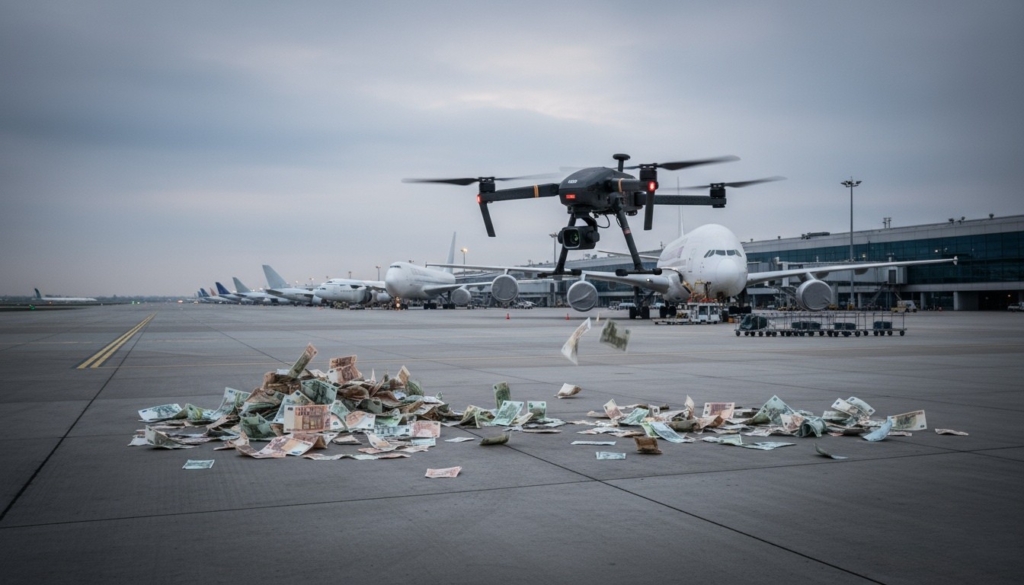
Under EU Regulation 261/2004, airlines must compensate passengers for delays and cancellations, adding significant liability. Although there is no publicly available aggregated data on the 2025 incidents, the Gatwick Airport (2018) drone incident led to over 1 000 canceled or diverted flights, affected approximately 140 000 passengers, and caused combined losses exceeding £50 million for airlines and the airport.
Beyond the financial toll, these disruptions erode public confidence in aviation safety and expose systemic weaknesses in airspace control. For governments, frequent or coordinated incursions raise the specter of hybrid threats: tactics designed to test preparedness, response protocols, or cause economic disruption without direct confrontation.
Ultimately, drone incursions have become a high-stakes test of operational continuity. The cost of a single serious disruption shows why investment in reliable, regulation-compliant counter-UAS solutions is not merely a technical necessity but an economic imperative.
Operational Limitations of Counter-UAS Technologies for Airports
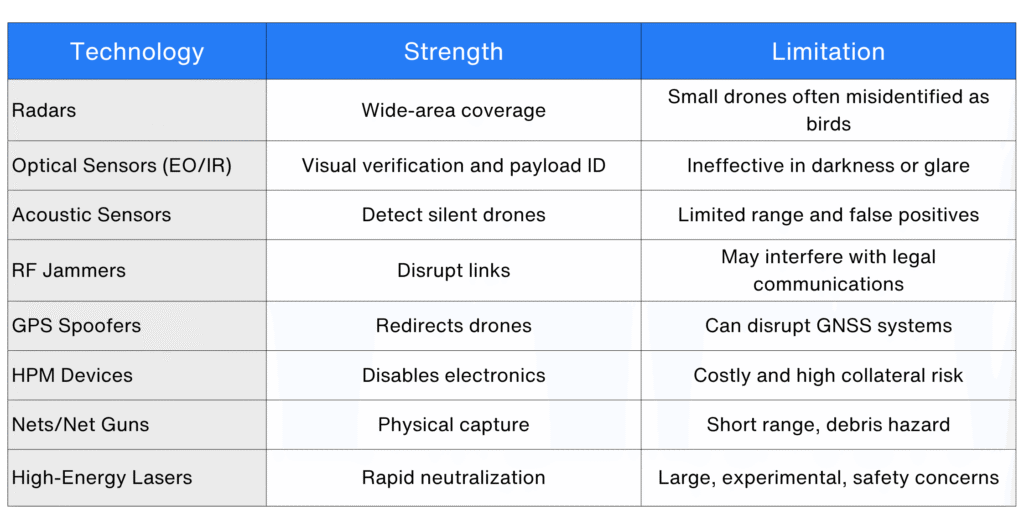
Despite rapid innovation, no single method offers a comprehensive or risk-free solution, especially in regulated civilian environments. Each detection and mitigation approach has limitations: technical blind spots, environmental dependencies, and safety or legal constraints.
These constraints make it clear that physical or signal-disruptive systems alone cannot meet modern airport requirements.
Why Cyber Over RF Sets a New Standard for Airport Security
The 2025 disruptions showed that traditional counter-UAS measures struggle to deliver precision, control, and compliance. Cyber Over RF (CoRF) provides a fundamentally different approach by analyzing the radio-frequency protocols used by drones, identifying operator-to-drone links, and enabling safe, targeted mitigation.
Key Advantages of CoRF
Real-Time Situational Awareness: Provides full visibility into airspace, identifies drones by communication signature, locates operators, and enables controlled landings.
Precision Without Interference: Targets only hostile drones; leaves GNSS, Wi-Fi, and authorized systems untouched.
Control Instead of Chaos: Allows security teams to act lawfully and decisively without disrupting normal operations.
Safe Coexistence with Authorized Operations: Differentiates between cooperative and rogue drones.
Compliant and Aviation-Ready: Meets aviation-safety and RF-regulatory requirements.
Adaptive and Future-Proof: Recognizes new protocols using AI-assisted decoding.
Flexible Integration Across the Airport Ecosystem: Scalable for runways, rooftops, or mobile patrols.
Sentrycs Cyber Over RF: The Evolution of Airport Counter-Drone Protection
Sentrycs has developed a simple, effective, and proven counter-UAS solution that meets the demanding standards of modern aviation, where precision, compliance, and continuity are non-negotiable. Our Cyber Over RF (CoRF) technology does not just detect a threat; it restores control, allowing airports to act decisively and lawfully, neutralizing unauthorized drones without affecting legitimate operations.
Flexible deployment: Scalable for fixed installations, mobile patrols, or temporary coverage.
Protocol-based detection: Identifies unauthorized drones and operators in real time.
Safe mitigation: Ensures zero interference with GNSS, communications, or flight-critical systems.
Cyber Over RF represents the next phase of airport airspace protection, enabling safe, compliant, and uninterrupted operations through precision, confidence, and certainty.
Frequently Asked Questions About Drone Disruptions at Airports
Q1: What happens when a drone enters restricted airport airspace? Authorities suspend take-offs and landings until the drone is located or neutralized, to avoid mid-air collisions or interference with aircraft navigation systems.
Q2: How do airports detect and identify drones? Airports use radar, optical, and RF-based sensors, often integrated with counter-UAS platforms such as Cyber Over RF, to detect and classify drone threats in real time.
Q3: Why is Cyber Over RF safer than jamming or laser systems? Because it operates at the protocol level, it targets only the unauthorized drone’s communication link, ensuring no disruption to Wi-Fi, GNSS, or aviation systems.
Q4: What are the economic effects of drone disruptions? They include flight cancellations, compensation costs, and loss of airport revenue. Gatwick’s 2018 incident alone caused over £60 million in losses.