









For state and local public safety agencies, drone incidents are no longer isolated events. From mass gatherings and emergency response incidents to a wide range of law enforcement operations, unmanned aircraft are becoming an increasingly routine operational challenge.
Until now, however, the authority to actively respond to these threats has largely remained in the hands of a limited number of federal agencies.
The recently published Interim Final Rule (IFR) implementing the US SAFER SKIES Act represents a significant shift in that landscape. By establishing the operational framework for State, Local, Tribal, and Territorial (SLTT) law enforcement and correctional agencies to conduct counter-UAS operations without relying on federal agencies for support on the ground. The rule opens the door for a broader, more distributed approach to protecting communities from malicious or unauthorized drone activity.

More Than New Authority
While much of the discussion surrounding the SAFER SKIES Act has focused on expanding counter-drone authority, the Interim Final Rule is about much more than granting permission.
Rather than simply enabling agencies to act, it establishes how they are expected to operate. The framework defines requirements for training and certification, approved technologies, operational procedures, coordination with federal authorities, reporting, and ongoing compliance.
This distinction is important.
Effective counter-drone operations are not simply about detecting a drone and selecting a mitigation strategy. They require qualified personnel, trusted technology, clear operational procedures, and accountability throughout the engagement. The Interim Final Rule recognizes that successful counter-UAS programs are built on operational readiness as much as on legal authority.
For agencies preparing to take on these new responsibilities, the question is no longer simply whether they have the authority to respond, but whether they are equipped to do so effectively, safely, and consistently.
The future of counter-UAS will be defined not simply by who can respond, but by who can respond responsibly.
Preparing for Operational Success
As agencies begin evaluating how to build or expand their counter-drone capabilities, several operational considerations become increasingly important.
Simplicity Matters
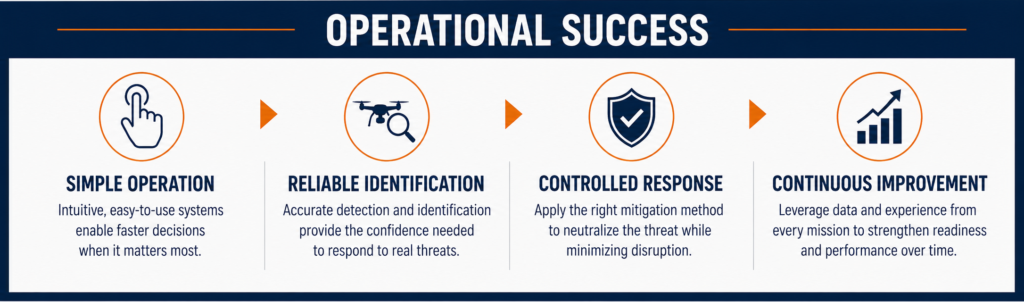
Many agencies will not have dedicated counter-drone units staffed by specialists at this time. Counter-UAS capabilities will often become an additional responsibility carried by law enforcement personnel already performing a wide range of missions.
Systems that are intuitive, easy to learn, and simple to operate can help new users and agencies deploy capabilities more efficiently by reducing training requirements and ultimately operator workload. Technology should enable operators to make faster, better-informed decisions – not add unnecessary complexity during time-critical incidents.
Reliable Threat Identification
With expanded operational authority comes an equally important responsibility: ensuring that any decision to mitigate a suspicious drone is based upon accurate information.
Operators will rely on two key elements to make any decision, the first is time (often referred to as stand-off) by detecting the drone further away from the controlled airspace provides officers on the ground with time to evaluate decisions. With certain technologies (e.g. ATL-2 RF Protocol Manipulation) the exact location of the pilot is identified and a common strategy employed by agencies is to dispatch officers to their location instead. The second element is confidence that they are responding to a genuine threat. Reliable drone identification, continuous situational awareness, and the ability to distinguish between authorized and unauthorized aircraft all contribute to better operational decisions while reducing unnecessary responses.
As drone activity continues to increase, confidence in threat identification will become just as important as effective mitigation.
Controlled Response
Not every drone incident requires the same response.
The ability to apply an appropriate, proportional mitigation strategy, based on the operational environment and the nature of the threat, is becoming an increasingly important element of modern counter-UAS operations.
Equally important is how that response is carried out. Counter-drone operations often take place in complex environments where public safety communications, critical infrastructure, authorized drone operations, and everyday civilian activities continue alongside the threat itself. Effective mitigation should neutralize the threat while avoiding unnecessary disruption to these legitimate operations and minimizing unintended collateral effects.
Ultimately, the objective is not simply to stop a drone, but to resolve the incident with the appropriate level of response. Agencies should therefore evaluate counter-UAS technologies not only by their ability to defeat a drone, but also by how precisely and responsibly they achieve that outcome.
Continuous Improvement
As more agencies begin conducting counter-UAS operations, each mission becomes an opportunity to strengthen future readiness.
The ability to capture, retain, and share operational data will become increasingly valuable, not only for meeting emerging reporting requirements, but also for supporting training, after-action reviews, continuous improvement, and stronger coordination with federal partners.
Counter-drone programs should therefore be designed not only to respond to today’s threats, but also to continuously improve as missions, technologies, and operational requirements evolve.
A Defining Moment for Counter-Drone Operations
The Interim Final Rule is more than a regulatory milestone – it marks the beginning of a new chapter in how counter-drone capabilities are integrated into everyday public safety operations across the United States. As authority expands beyond federal agencies, success will increasingly depend on the ability of state and local organizations to deploy capabilities that are effective, responsible, and operationally sustainable.
The agencies that prepare now, by investing in the right technologies, training, and operational concepts, will be best positioned not only to counter evolving drone threats, but to do so safely, confidently, and with the level of control that modern public safety operations demand.
Contact us to learn more about how Sentrycs supports state and local agencies with scalable, Cyber-over-RF counter-drone solutions designed for safe, controlled, and effective threat mitigation.